Readable in a single sitting. Practically useful for years. The chapter on starting before you feel ready is the one I needed at 23 and nobody gave me.
A new book, coming soon
How young founders turn ideas
How young founders turn ideas
into momentum without
losing themselves.
Build Good Things is an honest, practical guide to starting something real, and seeing it through. Built around five principles that work.
No spam. Just a quiet note when the book is ready.
The part people do not post
Most founders are not walking around with perfect plans and unshakeable confidence.
They are learning in public. Improvising more than they admit. Trying to stay steady while the ground keeps shifting. And quietly hoping nobody has noticed how much they are figuring it out as they go.
Real business is not polished all the time. It involves making consequential decisions with incomplete information, staying composed when you do not feel it, trusting people before you have evidence to fully justify the trust, and building things without being certain they will work.
Most of the business books on the shelf were written from the comfortable position of knowing how it turned out. The messy middle has been edited out for narrative clarity.
This book is written from inside it.
The world does not need more noise. It needs better businesses, built by better people, for better reasons.
The Good Things Method
Five principles. Applied consistently.
Five principles. Applied consistently.
One clear direction.
The Good Things Method is the operating system behind the book. Five principles that give you the best possible chance of building something that lasts, without losing yourself in the process.
01
Notice
Spot real problems close to real people.
Not imagined problems. The kind of friction and frustration that shows up repeatedly in real lives and that people have accepted because nobody has fixed it yet.
02
Start
Take the first useful action before confidence fully arrives.
Confidence is a consequence of starting, not a prerequisite for it. The readiness you are waiting for was always going to come from doing rather than planning.
03
Test
Build small. Charge early. Learn from what people actually do.
Not what they say they will do. Behaviour tells you the truth. Big dreams are good. Big guesses are expensive.
04
Trust
Do what you say. Listen properly. Follow up consistently.
Trust is built through a thousand small, reliable actions accumulated over time. Clever ideas get compliments. Real problems create customers. Trust creates businesses.
05
Sustain
Protect your health. Build simple systems. Create something that lasts.
A business that requires you to destroy yourself to maintain it is a hostage situation with invoices. Build for the long game.
"Good businesses are not built from hype. They are built from genuine usefulness, from trust earned through consistent action, and from the kind of steady effort that compounds over time into something significant."
What the book is really about
This is not a book about thinking bigger or moving faster.
It is a book about building well. Not perfectly, not impressively. Just well. With honesty. With genuine attention to the real problem in front of you. With care for the people who will use what you build.
The book draws on real experiences across businesses built and broken, capital raised and lost, teams kept on through nine months without a salary, and the slow, unglamorous work of doing what you said you would do. Consistently. In the small moments. When it costs something.
That sounds simple. It turns out to be rare.
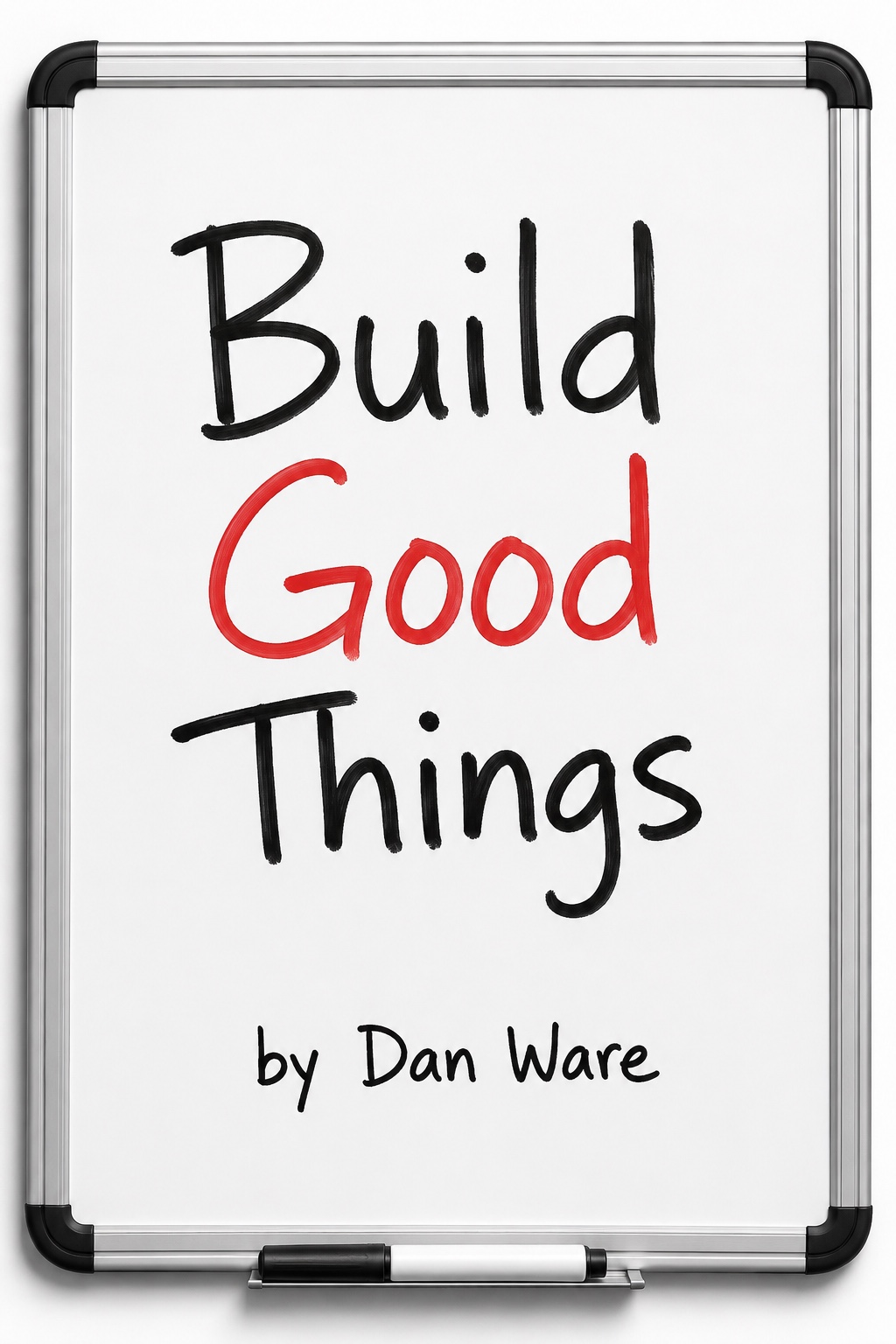
Build Good Things
The Book
Fifteen chapters. Five parts. One honest account of what building actually requires.
Written for young founders who are already in it, and want to do it better.
Build Good Things works through five principles: Notice, Start, Test, Trust and Sustain. Each comes with real stories, hard-won insight and practical ideas that transfer from the page to the room.
It is not written from the comfortable end of hindsight. It is honest about the nights staring at the ceiling, the decisions made badly under pressure, the team kept on for nine months without a founder taking a pound. The parts people do not post.
- • Five parts: Start Real · Move With Clarity · Build Trust · Build With People · Build Without Breaking
- • Real stories: from Holiday Inn night shifts to VC conversations, from administration to starting again
- • Business and personal growth actions at the end of every chapter
What the book gives you
Not a formula. A different way of working.
Readers say it is not the method that changes things. It is the permission it gives them to do things differently.
Preparing indefinitely, waiting to feel ready
A clear understanding of why starting imperfectly beats waiting perfectly
Building too much before learning if it is wanted
The discipline to test small and trust what behaviour tells you
Letting good opportunities drift through no follow-up
A system for maintaining momentum without relying on memory
Running at full capacity, making worse decisions
Understanding your energy as the engine, and protecting it accordingly
Building everything in your own head, becoming the bottleneck
Simple systems that free your best thinking for the work that actually needs it
Advice that sounds right in theory
Principles written from the room, not from theory, that actually transfer
Who this is for
This book was written for you, if…
- You are early in building something and want a foundation that will actually hold under pressure.
- You have been preparing for long enough that you suspect preparation might be the problem.
- You are moving fast but something feels unsolid, and you cannot quite put your finger on what it is.
- You want to build something that genuinely matters, not just something that looks good on a pitch deck.
- You are tired of business content that sounds smart and transfers to nothing.
This book is not about building the biggest thing. It is about building something worth building.
What early readers say
Most business books are written from the other end. This one is written from inside the process. You can feel the difference on every page.
The five principles gave me a framework I actually come back to. Not in a theoretical way. When I'm stuck, when I'm deciding, when I need to remember what we're building and why.
From the Journal
All posts →
Thinking about building well.
Start
The most common story nobody tells
Most people do not fail because they started badly. They fail because they never started properly at all. On why preparation is often just fear with better stationery.
Read →Trust
Nine months without a salary
What it actually felt like to keep a team on full pay while taking nothing myself. Reliability is easy when things are going well. The real test is what your word costs you when they are not.
Read →Sustain
This is chapter three, not the ending
What a mentor said when my business went into administration, and why it mattered more than it sounds. On optimism without denial, and how to hold both things at once.
Read →
The book is coming
Be the first to know when
Be the first to know when
Build Good Things is live.
Leave your name and email and I will send you a quiet note the moment the book is available. No noise before then. Just the signal when it matters.
✦
You are on the list.
I will send you a quiet note the moment Build Good Things is live. Thank you. It genuinely means something.